




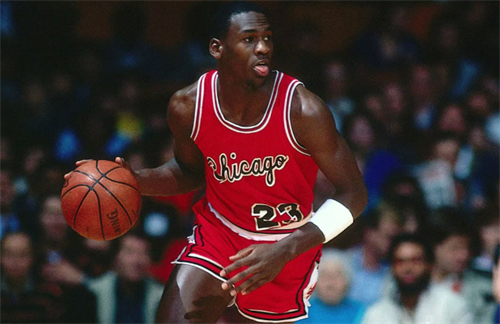
Every great offensive idea in basketball is eventually tested by time. Defensive schemes evolve. Rules change. Athletes get longer, faster, and smarter. What once felt unstoppable becomes, at best, situational.Few concepts symbolize this tension between history and modernity more than Michael Jordan’s “bottom rack.”
In its heyday, the bottom rack was elegant in its simplicity. Baseline spacing. Weak-side movement. A staggered rhythm that forced defenders to choose between staying home or surrendering space. Jordan used it not as a rigid set, but as a framework—one that allowed him to attack from the post, the baseline, or the mid-range with surgical precision.
But the modern NBA is a different ecosystem. Hand-checking is gone. Defensive three-seconds shape paint coverage. Switch defense is now a default, not a counter. Legal verticality and freedom-of-movement interpretations have reshaped how contact is officiated.So the question is no longer nostalgic. It is technical and practical:
Does the bottom rack still work under today’s defensive rules?
This article breaks the concept down piece by piece—its original structure, the rule changes that matter most, how modern defenses counter it, where it still succeeds, and how it must evolve to remain viable in today’s NBA.
Defining the “Bottom Rack”: Tactical Anatomy
The bottom rack is best understood not as a single play, but as a baseline-oriented spacing system. Its defining elements include:
-A shooter stationed in the weak-side corner;
-A cutter or screener near the short corner or dunker spot;
-A wing occupying the strong-side slot or elbow;
-The ball initiated from the wing or mid-post;
The geometry is intentional. Baseline spacing stretches help defenders horizontally, while staggered movement creates vertical pressure. The defense is constantly deciding whether to protect the rim, deny the post-up, or stay attached to shooters.
Jordan exploited this alignment in multiple ways:
-Quick baseline drives when defenders overplayed the middle;
-Post-ups against single coverage when help stayed home;
-Kick-outs to the corner when rotations arrived late;
Spacing theory supports this logic. Optimal offensive spacing keeps defenders 15–18 feet apart, reducing the efficiency of help rotations and increasing the success rate of both drives and kick-outs.[1]
What made the bottom rack lethal wasn’t complexity—it was decision pressure. Every cut forced a reaction. Every reaction created a window.
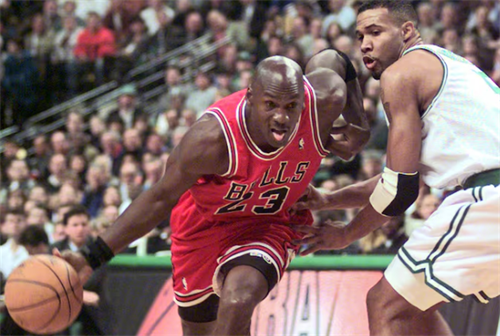
The Rule Changes That Matter:
To evaluate the bottom rack today, we have to understand how the rulebook has reshaped half-court offense.
1. Hand-Checking Restrictions
In the early 2000s, the NBA sharply limited hand-checking on the perimeter. Defenders could no longer guide ball-handlers with forearms or impede cutters with sustained contact. This fundamentally changed how offenses attack off the dribble.
For baseline actions, this is a double-edged sword. On one hand, cutters move more freely. On the other, defenders are trained to anticipate movement earlier, relying on positioning rather than contact.
2. Defensive Three-Second Rule
The defensive three-second rule prevents defenders from camping in the paint without actively guarding an opponent.
This rule theoretically helps baseline offenses by opening the lane. In practice, it has produced faster, more coordinated rotations. Defenders step in and out of the paint precisely, timing help rather than sitting in it.
3. Legal Verticality and Freedom of Movement
Modern officiating emphasizes vertical contests and restricts off-ball grabbing. Defenders must contest shots straight up, while cutters are protected from illegal contact away from the ball.
This helps baseline movement—but only if it is dynamic. Static alignment without motion allows defenses to load up legally and rotate cleanly.
How Modern Defense Counters the Bottom Rack
Modern NBA defenses are designed to attack predictability.
1. Switch Defense as the Default
Switching is no longer situational. It is foundational. Long wings and mobile bigs switch screens to eliminate advantage before it forms .[2]
Against the bottom rack, switching neutralizes staggered actions and prevents clean post entries. What once created confusion now creates a matchup reset.
2. Drop and Ice Coverage
In pick-and-roll situations layered into baseline spacing, teams use drop coverage to protect the paint and “ice” principles to deny baseline drives. The goal is to force ball-handlers toward help and away from the short corner.
This funnels offenses into mid-range pull-ups or late-clock bailouts rather than rim pressure.
3. Early Help and Weak-Side Sag
Modern defenses pre-rotate. Weak-side defenders sag into gaps early, daring offenses to make skip passes over length. Baseline cuts are met not by late reactions, but by planned rotations.
This is where traditional bottom rack concepts often fail—because they assume defenders react, rather than anticipate.
Where the Bottom Rack Still Works:
Despite these counters, the bottom rack has not disappeared. It has simply become situational.
1. Mismatch Hunting
When switching produces a slow big on a wing shooter or a guard defending the post, baseline spacing can isolate that mismatch. The rack works best when it forces defenders to guard outside their comfort zone.
2. Screen Timing and Angles
Legal screens still matter. Properly set flare screens, slips, and re-screens can momentarily freeze defenders—even in switching schemes. Officiating allows screens that are stationary and well-timed, which is enough to create separation.
3. Late-Clock Discipline
In late-shot-clock scenarios, defenses hesitate. Over-helping risks fouls or open threes. Patient baseline movement can exploit that hesitation with backdoor cuts or quick post seals.
Case Studies: Modern Usage
1. Successful Example: Golden State Warriors
The Warriors do not run the bottom rack in its original form, but they use its principles constantly. Weak-side corner shooters, baseline cuts, and staggered off-ball screens are staples of their offense.
Their success comes from layering baseline spacing with relentless motion and elite shooting gravity .[3]
2. Failed Example: Poorly Spaced Lineups
Teams without reliable shooters often attempt baseline spacing without gravity. Defenses sag, clog lanes, and rotate aggressively. The rack collapses because spacing exists on paper, not in threat.
Film-room lesson: spacing only works if defenders believe the shot is dangerous.
Modernizing the Bottom Rack:
1. Personnel Adjustments
Stretch bigs pull rim protectors away from the paint;
Switch-resistant wings punish mismatches;
Mobile rim protectors allow offensive counters without sacrificing defense;
2. Motion Modifications
Static alignment must give way to:
Slip screens;
Delayed flares;
Dribble handoffs into pick-and-roll;
These actions force defenses to communicate continuously, increasing the chance of breakdowns.
3. Counters to Switching
Re-screens, quick drives against mismatches, and skip passes punish aggressive switches. Instead of fighting the switch, modern offenses attack the result of it.
Practice & Drill Recommendations
1. Spacing Drills
Corner relocation shooting
Baseline cut timing drills
2. 3v3 / 4v4 Switch Drills
Simulate switch and hedge reactions
Emphasize read-and-react decision making
3. Shooting and Read Drills
Corner three conversion
Drive-and-kick sequencing
Risks and Limitations:
Predictability:If the same player occupies the same spot every possession, defenses load early.
Personnel Constraints:Without shooting and ball-handling, baseline spacing becomes decorative, not functional.
Game Context:When trailing late, early offense and quick pick-and-rolls often outperform patient baseline actions.
Jordan’s bottom rack can still be effective under today’s defensive rules, but only as an evolved, situational tool rather than a primary offensive system. Its core principles—spacing, timing, and decision pressure—remain highly valuable, yet the structure must adjust to modern defenses defined by switching, anticipation, and length. The bottom rack works best when it targets mismatches, operates late in the shot clock, and is supported by elite shooters and intelligent cutters; it loses effectiveness against disciplined, switch-heavy defenses, lineups with poor spacing, or game situations that demand a faster pace. Ultimately, the bottom rack’s modern relevance lies not in copying its original form, but in adapting its ideas intelligently to contemporary NBA conditions.
Source:
[1]Underdog Hoops. (n.d.). The science of spacing in modern basketball. https://underdoghoops.com/the-science-of-spacing-in-modern-basketball/
[2]TalkBasket.net. (n.d.). How defensive schemes are evolving to counter modern NBA offenses. https://www.talkbasket.net/199842-how-defensive-schemes-are-evolving-to-counter-modern-nba-offenses
[3]Fanspo. (n.d.). Space, pace, and modern NBA offensive theory. https://fanspo.com/nba/s/general/p/htGSUUs5X6zHAN/space-pace-and

Three Basic Strategies for Safely Carrying the Ball Over the Half-Field in the Face of Pressured Defense